About Me

My photo
just shooting questions to the universe and hoping that when the right time comes I will receive some answers, or if not, I will be given something to enrich my life.

Tuesday, March 16, 2010

Pick up your sleeping-mat and walk

Jesus said, 'Get up, pick up your sleeping-mat and walk around.' (John 5:8)

Jesus asks us to face our fears, to hold in our hands and look in the eye that which paralyses our lives. It is quite a heavy task for many because there is always that instinct in us to defend ourselves from hurt and failure. So, very often, we just set aside these fears, hoping to pacify them; thinking that if we don't mind them, they will magically lose their power over us.
Paradoxically, though, the more we don't face them, the more they become monsters seeping us of energy and draining us of our joy.
Jesus tells us to face them, but face them with the power of Jesus. That is the secret. Alone we are weak, but with Him by our side, our monsters lose their power.

Friday, March 12, 2010

Transformed in God's hands


Let us allow God to prune us. Tears are inevitable. But even in the midst of tears, we can always say our fiat , no matter how faint it is, trusting that the little we offer could be transformed in God's hands.

A parable for all


This coming Sunday's Gospel reading is from Luke 15:1-3, 11-32, famously entitled the Parable of the Prodigal Son. Here are some parts of a comment I found very interesting:

At different times in our lives, most of us have played each of these roles: that of the doting, loving, apparently overindulgent parent; that of the younger son who experiences being brought low by sinfulness and pride, and desperately in need of mercy; the older son, who is responsible and above reproach, and who is frustrated by the generosity and leniency with which the weaknesses and sins of others are dealt with.
This deeply moving parable highlights two of Luke's characteristic emphases: God's welcome of sinners and those considered socially and religiously unacceptable, and the rejoicing and celebration that are meant to accompany that welcome, that are meant to respond to the repentance that God invites.
The generous father of both sons welcomes back the youth who squandered his inheritance but does not repudiate the older son who protests the father's prodigality yet remains faithful to him. "Son, you are always with me, and all that is mine is yours" (v 31). The restoration of the son who "was dead and has come to life" who "was lost and has been found" (v 32), does not invalidate the fidelity of the older son. The younger son, restored to the father's household, must make a new beginning in the life of fidelity. Reconciled to God, both sons must work out together their reconciliation with each other.
Does the elder son finally make peace with his brother and welcome him back? Does he find it in his heart to forgive, and to share in the father's rejoicing? Or does he, in the final accounting, find himself even more alienated than his younger brother had been? Where is the mother in this story? What was her response? We are left hoping for a conclusion that Jesus never provides. That's what parables are all about: They invite us to enter into the story and to find the answers in our own lives and times.
The parable of "The Wayward Son" or "The Prodigal Father" or the "Indignant Elder Brother" can cause much grief for us, as we see ourselves and our motives exposed for what they really are. The prodigal Father squanders his own love on our pettiness, our meanness, our diffidence, and our arrogance.

Fr. Thomas Rosica, CSB

Monday, March 8, 2010

God's patience


Yesterday's Gospel is a very challenging one for me, in terms of the God that I believe in. In fact, the reading guide entitles it "Repent or perish".

The God I believe in is Love that knows no bounds. It's not just an idea of mine but Scripture itself confirms this:
For this is how God loved the world: he gave his only Son, so that everyone who believes in him may not perish but may have eternal life. (John 3:16)

There are so many other Scripture texts that show the same face of God.

How then can I understand this text of Luke 13:1-9. I am not an exegete, but in my everyday life, the Word of God gives me nourishment. I hope that it is not superstition, but in difficult times, it is God's promises that give me hope or a new lease on life. God's Word may not give me the answer to a pressing question, but It definitely helps me to hang on or to view the question from another perspective.

Well then, what is the message for me of this Lucan text? God is always patient. His patience knows no bounds. The "one more year" mentioned here in the text is not the literal one year according to our time measurement. The one year here is our "limited time" here on earth. God continues to nourish us and to give us what we need to attain true joy. He does His part but we have to do ours. When our "time is up" and we have to be "cut off", it is not that God has condemned us or has stopped dealing with us kindly; rather, it is we who have hardened ourselves, refusing His invitation to joy and fullness of life.

In the end, it is not He who condemns us, but we who condemn ourselves by choosing a pattern of refusing His love. Nothing in life is improvised. The daily no's that we say to God's love hardens our heart and leaves it closed to God's all-pervading kindness.
Thursday, March 4, 2010

Kindness everywhere

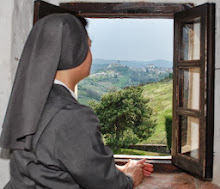
The other day I woke up wanting to embrace the world and to love it as it is. It is quite strange since for a long period I have been having a succession of "gray days", that just to get through one day was already a triumph for me.
Anyway, it just suddenly entered my mind that I am surrounded by kindness everywhere. At table, during meals, I am in the company of my sisters who try their best to make our short time together energizing. It's not that I have a whole company of loquacious people, but I feel that each one tries to give the best of herself to be of good company to the others.
One afternoon I almost had a misunderstanding with a person, not out of malice but because of a miscommunication, and the other sister just enters the picture trying to lighten the situation and saying that I was actually there to say thank you and to greet them.
I have another sister who is very attentive and who manages to uplift my spirits with just a greeting or a few words.
And I can go on and on and on.
Living in community is certainly not easy. We are all so different. Even a common project couldn't prevent misunderstandings since each one has a unique personality and so understands things in a different way.
But I need to remember that each one is just like me, a pilgrim trying to make sense of life, with its ups and downs. Learning to forgive, myself and others, will make me more open to kindness that is everywhere.