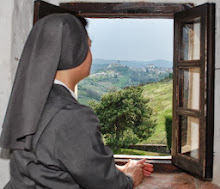
About Me

My photo
just shooting questions to the universe and hoping that when the right time comes I will receive some answers, or if not, I will be given something to enrich my life.

Wednesday, August 4, 2010

Open hands

Give us this day our daily bread ...
Give me only what I need for today, Lord. It's very tempting to hoard - things, persons, experiences - thinking that I am "saving for the rainy day". But the more I accumulate securities, the more I am less secure. The more I store goods, the less I have the time and the spontaneity to truly enjoy them.
My heart and my desires are never fully satiated. I realize that as soon as I attain a goal, I am running after a new one. So my life is a never-ending race without a purpose.
May I have open hands to receive and to give, to accept and to let go, knowing that I have all that I need to be happy today. Whenever I close my hands to protect what I have, I also close my heart to adventure and spontaneity. I imprison myself in walls which I call security. Can I truly be secure inside a prison?
Give me open hands to receive the daily bread that I need. I will be happy today.
Tomorrow is not a problem. Tomorrow is my today in the future, and I know that I have no need to worry because in every today You are present.

Sunday, August 1, 2010

Tender mercies

I've learned that the high point of any narrative is the moment of crisis that is triggered by a strong experience. And from the crisis point the narrative comes to its resolution.
Telenovelas are popular because they tend to involve the viewers especially in that moment of crisis when the protagonist and the villain are at their best, opposing forms. That highpoint is easy to identify because it is really the crux, where energies and words are at their highest and lowest.
But in life it rarely happens, or maybe I'm speaking about my life. It is more like an accumulation of little and ordinary daily things that you just take for granted. They're what I call the hassles of everyday life. They are like termites. They eat you up slowly but surely, until you just wake up one day and ask yourself "how have I arrived at this point?"
There is also no single point when you just say to yourself, "It has been resolved" or "I have already passed it". Sometimes no forgiveness is asked or given. You just live one day at a time. And time itself heals you slowly, through little, awkward steps, little and silent signs, small things which I call tender mercies.

Saturday, July 31, 2010

Lost

I have experienced in my life how I would, sort of, want to plunge all the way down, to reach the depths, reasoning out that after the depths there is no other way but up. It is as if in sinking all the way down, I will be able to exorcise my demons. It's like an attitude of just-get-it-over-with. It's like, for example, I just want to be irresponsible for once, to break the humdrum and monotony, to give in to my spontaneous self. Or is it?
These days I have become more aware that when moments like these come, and I am just ready to surrender, there is one part of me that just doesn't give up. I cannot really explain it rationally. When I am just ready to give in, I just do the opposite, which in this case is often the responsible thing to do, though in reality, logic and responsibility had nothing to do with it. It was like a spur of the moment thing, or maybe a habit that is hard to break.
It is not me who is at work, in moments like this. Does it mean I have lost my autonomy? Are my actions fruit of a decision, as human acts ought to be?
I am really in a maze here. Or maybe, life itself is a maze.

Monday, July 26, 2010

For better or for worse

Two days ago I got a message from a high school classmate. He was hoping to catch me online on Facebook because he almost committed suicide. He just wanted to share and let it all out to me because I am a nun. I am the only nun in our high school class and my former classmates often tell me that they are very lucky to have a nun among their high school classmates. As if I am their direct line to God.
I think people have such a high expectation of nuns. They think that we should always be good, patient, prayerful, etc., etc. Well, I do not say that we shouldn't be that. What I mean is, many people don't even realize that we, too, have our moments of weakness, of moods, of failures, of tiredness, and yes, of sins, too. We are not perfect. We are much like any person on the street burdened with our family history, our tempers, our midlife crisis, our sickness, etc., etc.
When I was younger I was always fascinated by weddings. I was a member of a Church choir and we always sang at weddings. I have memorized the wedding vows and while the bride and groom exchanged them, I would even say the words with them - for better or for worse.
When I entered religious life I was full of ideals and expectations. I did not even question some of the traditions which I found impractical, because for me the ideal was what is most important. I wanted to give my all to God who is my only Good, my only Lord, my only Love.
Eighteen years after my first profession, I realized that while I was making my vows I should have made them with the spirit of "for better or for worse". My pact with God encompasses my whole being. He didn't call me because I am the best. Why He called me, He alone knows the reason.
Everyday is an invitation for me to say "for better or for worse, dear Jesus, I am staying with you". Everyday, too, Jesus assures me "for better or for worse, dear Bing, I'm sticking it out with you".

Saturday, July 24, 2010

She loved much

Mary Magdalene is one of my favorite saints. The other day, July 22, was her feast.
Tradition has attributed to her different figures of women in the Gospel like the woman caught in adultery, the woman who anointed Jesus' feet with expensive perfume, the woman who stayed together with Jesus' mother at the foot of the cross, and the woman to whom Jesus first appeared on His resurrection.
What I like best about Mary Magdalene was her "all-or-nothing" attitude. If she was really the woman caught in adultery, then it is just one instance that shows her guts to give all, even risking her life. When she stayed at the foot of the cross, she also risked her life. When she ran to the apostles to bring the Good News of Jesus' resurrection, she risked her reputation.
When we love, we take risks. When we don't take risks, ours is not love but self-interest.
Taking risk means being vulnerable, accepting the possibility of betrayal and rejection. Is it then worth it? Is it worth it baring our heart and soul only to be rejected? I do not know. The problem with life is that it does not present clear-cut answers. There is always the gray area.
What I know is that God blesses this "all-or-nothing" risk-taking. Who loves much may experience many rejections, have her heart broken many times over, but that heart is being fashioned from a heart of stone, strong and impenetrable, to a heart of flesh.
Only a heart of flesh can understand the depth of love, how a love that is offered is not an idea; rather, someone has decided to take the risk of rejection because you are worth the risk.

Wednesday, July 14, 2010

Jesus in my heart

It's not for malice or ill-will that we don't know how to listen to people. I think it's because we are caught up in our production-oriented or efficiency-addicted world.
Despite our hyper-talk on the importance of community life, that it is the one that sustains our vocation, we water down community life to staying in the same house, praying at the same time, eating at the same time and at the same place, drafting a community plan and evaluating it. Some communities manage a step further and do have fun together; but very few are those where the members feel at ease in admitting their wounds and exposing their vulnerabilities, or sharing their inspirations and dreams.
We are fortunate when we find people who can be this for us. But they are not always around. I believe that God, our Provident Father, gives them to us at the right time, when we really need them. But, in the end, we need to "climb our mountains all alone", and to experience that in this solitude we are not really alone "Jesus is our true friend, our lifetime friend".
It's not rhetoric for me when I say this. I have experienced this, and I continue to do so. Jesus is here, in my heart. When I can be intimate with my self, when I am not afraid to accept myself as I am, it is to Jesus that I am exposing my self. When I manage to rise up, or just to drag myself through a difficult period, it is Jesus who tells me that I have it in me to be resilient and not to surrender.

Sunday, July 11, 2010

Go and do likewise

There was a scholar of the law who stood up to test him and said, "Teacher, what must I do to inherit eternal life?" Jesus said to him, "What is written in the law? How do you read it?" He said in reply, "You shall love the Lord, your God, with all your heart, with all your being, with all your strength, and with all your mind, and your neighbor as yourself." He replied to him, "You have answered correctly; do this and you will live."
But because he wished to justify himself, he said to Jesus, "And who is my neighbor?" Jesus replied, "A man fell victgim to robbers as he went down from Jerusalem to Jericho. They stripped and beat him and went off leaving him half-dead. A priest happened to be going down that road, but shen he saw him, he passed by on the opposite side. Likewise a Levite came to the place, and when he saw him, he passed by on the opposite side. But a Samaritan traveler who came upon him was moved with compassion at the sight. He approached the victim, poured oil and wine over his wounds and bandaged them. Then he lifted him up on his own animal, took him to an inn and cared for him. The next day he took out two silver coins and gave them to the inn-keeper with the instruction, 'Take care of him. If you spend more than what I have given you, I shall repay you on my way back.' Which of these three, in your opinion, was neighbor to the robbers' victim?" He answered, "The one who treated him with mercy." Jesus said to him, "Go and do likewise."

This is one of Jesus' most famous parables. It is rich with insights as it presents to us what is the key to a meaningful life. I understand the scholar's question "What must I do to inherit eternal life?" as an expression of a desire to find the meaning of life. How can my life be meaningful, that makes it worth living and struggling?
The narration of the parable of the Good Samaritan is Jesus' way of explaining, without an official dogmatic presentation, that a meaningful life is not the result of following the law. Our lives acquire meaning, or rather, we discover that our lives have meaning when we become God-like. The Samaritan did what he did not because he was following the Law. He did what he did because he was moved by compassion, indeed, the very attitude of God.

What must I do to have a meaningful life? Acquire the mind and the heart of Christ who is Compassion.